Space Saving Loft Conversion Stairs: space saving loft conversion stairs guide
Figuring out how to get up to your new loft is one of the most important decisions you'll make. For anyone living in London, especially in a period property where every inch is precious, a standard staircase is usually a non-starter. It’s just too big. This is why space-saving loft conversion stairs are often the only real solution for turning a dusty old attic into a functional, beautiful room without chewing up space on the floor below.
Why Your Staircase Choice Is Critical for a London Loft
A loft conversion is one of the smartest ways to add living space and boost your property's value. But honestly, the whole project's success can hang on the staircase. It’s the bridge between your existing home and the new room, and if you get it wrong, it can mess up the flow of both floors.
In a typical London terrace, whether it’s Victorian or Edwardian, hallways and landings are already tight. Trying to squeeze in a bulky, conventional staircase can swallow a huge chunk of a bedroom or dominate a landing, making the floor below feel awkward and cramped. This is where clever design really comes into its own.
The Problem with Standard Staircases
Standard staircases are built for homes with plenty of room to spare. They have a gentle, comfortable pitch (the angle of the slope), which demands a long, uninterrupted run. In most London properties, finding that kind of space without sacrificing an entire room is pretty much impossible.
This challenge is made even trickier by the UK’s strict Building Regulations, which are not something you can ignore. They specify:
- Maximum Pitch: The stairs can't be steeper than 42 degrees in a home.
- Minimum Headroom: You need at least 2 metres of clear headroom over the entire staircase.
- Step Dimensions: There are specific rules for the height (rise) and depth (going) of each step to make them safe to use.
If you try to shoehorn a standard staircase into a tight spot, you’ll almost certainly fail on one of these points. The result? A design that’s illegal, unsafe, and will get flagged by building control.
The right staircase does more than just get you upstairs; it weaves the new loft seamlessly into your home. A badly planned one is a permanent obstacle, wrecking the functionality and feel of your living space.
The Solution: Smart Stair Design
This is exactly why space-saving loft conversion stairs are so essential. Clever designs like alternating treads, compact winders, or spirals are specifically engineered to meet Building Regulations while taking up a much smaller footprint.
In fact, 2025 data shows that access and stairs are a major cost in any loft conversion, so getting the design right from the start is key to keeping the project on budget. For builders and designers working in areas packed with period properties, these compact solutions are a must-have in their toolkit. You can learn more about how staircase costs factor into London loft conversions. By picking a space-efficient design, you hold onto that valuable square footage and end up with a stylish, compliant, and genuinely usable connection to your new loft.
Exploring Popular Space Saving Staircase Designs
Choosing the right staircase is a balancing act. You need to weigh up functionality, style, and the sheer physical constraints of your home. In a London property, where every square metre is precious, this decision is even more critical. Let's get into the most effective space-saving stairs for loft conversions, looking at the pros, cons, and where each design really shines.
This simple decision guide is a good starting point for figuring out which access route makes the most sense for your project.
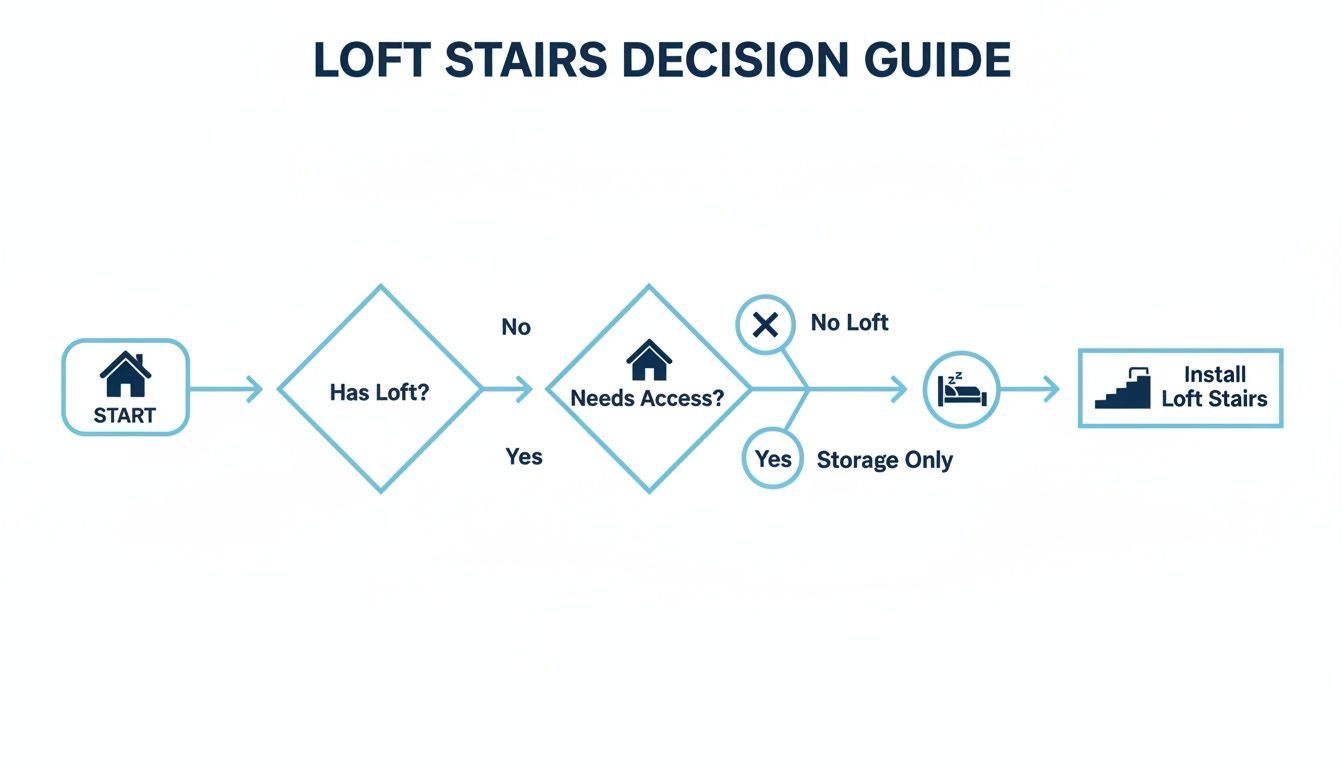
As you can see, once you’ve established the need for permanent access, the real evaluation of staircase types begins.
Alternating Tread Stairs (Paddle Stairs)
For the absolute tightest of spots, alternating tread stairs, often called paddle stairs, are an incredibly clever solution. The design is unique: each tread is shaped to take only one foot, alternating left and right as you go up. This allows for a much steeper pitch than a conventional staircase, dramatically cutting down its horizontal footprint.
Think of it as a very secure, fixed ladder. Because you only need space for the active foot on each step, the whole length of the staircase can be shortened quite a bit.
There's a crucial catch, though. Because they're so steep and unusual, Building Regulations usually only permit them when there genuinely isn't enough space for a conventional staircase. They must also lead to just a single habitable room. Honestly, they’re not ideal for main access routes, especially with children around or if you ever plan on moving furniture up and down.
Spiral Staircases
Spiral staircases often get the nod for their striking looks. Winding elegantly around a central column, they take up a minimal circular footprint, making them a fantastic option when a straight run just won't work. They can add a real architectural statement to a room.
The trade-off is practicality. Navigating a spiral staircase, especially while carrying a laundry basket or anything bulky, can be tricky. The inner part of each wedge-shaped tread is very narrow, so you naturally find yourself walking on the outer edge.
While they are a beautiful and efficient space saving loft conversion stairs solution, think about your daily routine. If the loft is going to be a frequently used master bedroom, the novelty might wear off quickly. They often work better for a home office, a studio, or an occasional-use guest room.
Compact Straight and L-Shaped Stairs
Sometimes, all you need is a slightly tweaked version of a traditional staircase. Compact straight or L-shaped (winder) stairs use a slightly steeper pitch (up to the 42-degree maximum) and reduced tread depths to squeeze into smaller spaces. An L-shaped or winder staircase has a turn in it, which helps break up the flight and tuck it neatly into a corner.
- Winder Treads: Instead of a flat landing, winder stairs use triangular steps to make the turn. This is a common and highly effective way to navigate corners in tight spots.
- Reduced Footprint: By nudging the steepness up a bit, you can shorten the staircase's overall length without resorting to a more radical design like paddle stairs.
These are often the go-to solution for loft conversions because they feel more familiar and are easier to use day-to-day than spirals or alternating treads. They hit that sweet spot between space efficiency and comfort.
A well-designed winder staircase can feel just like a standard flight but fit into a space you thought was unusable. It's often the most practical and compliant choice for a family home.
Integrated Storage Staircases
Why let all that space under your stairs go to waste? Integrated storage staircases are a brilliant two-in-one solution. This approach builds cupboards, drawers, or shelving directly into the staircase structure itself, turning a purely functional element into a major storage asset.
This is particularly valuable in smaller homes where you have to grab every storage opportunity you can get. You could have pull-out drawers in the risers or a full-height cupboard accessible from the side. This idea fits perfectly with the principles of efficient design, much like those seen in the trend of micro-renovations for maximising small spaces.
High-Quality Loft Ladders
Finally, it's important to give loft ladders a mention. If your attic is purely for storage and not a habitable room, you don't actually need a permanent staircase to meet Building Regulations. A high-quality, retractable loft ladder is a perfectly suitable and space-efficient option.
Modern loft ladders are sturdy, well-made, and often come with insulated hatches. They fold away neatly into the ceiling, taking up zero floor space when you're not using them. Just remember, this is only an option for non-habitable spaces. The moment you define the loft as a bedroom or office, a permanent, compliant staircase becomes mandatory.
To help you weigh up the options, here’s a quick comparison of the main staircase types we've discussed.
Comparing Space Saving Loft Staircase Options
| Staircase Type | Typical Footprint | Average Cost | Best For | Building Regs Compliant? |
|---|---|---|---|---|
| Alternating Tread | 0.8m x 1.5m | £800 – £2,000 | Extremely tight spaces, single room access. | Yes, under specific conditions (Part K). |
| Spiral Staircase | 1.2m – 1.8m diameter | £1,500 – £5,000 | Awkward corners, aesthetic statement pieces. | Yes, but with strict dimension rules. |
| Compact Straight/L-Shape | 0.8m x 2.4m | £1,200 – £4,000 | Most standard loft conversions, daily use. | Yes, a very common compliant solution. |
| Loft Ladder | None (retracts) | £300 – £900 | Storage-only lofts, non-habitable spaces. | No, not for habitable rooms. |
Each of these designs solves a specific problem. The key is to be realistic about how you'll use the loft space and what your home can physically accommodate before you fall in love with a particular style.
Navigating Building Regulations for Loft Stairs
While picking out a beautiful staircase is one of the more exciting parts of a loft conversion, making sure it’s safe and legal is completely non-negotiable. UK Building Regulations aren't just red tape; they are a critical framework designed to protect you and your family. For a loft conversion to be officially signed off as a habitable room, its staircase has to meet these strict standards, especially when it comes to fire safety and providing a safe escape route.
Getting this right is fundamental. A non-compliant staircase will fail the building control inspection, which inevitably leads to costly and disruptive work to put it right. But don't worry—getting your head around the core rules is more straightforward than you might think. We'll break down the key requirements so you can plan your space saving loft conversion stairs with confidence.
The Headroom Rule
One of the very first hurdles you'll face is headroom. The regulations are pretty clear: you need a minimum of 2 metres of clear vertical space above the pitch line of your stairs. The pitch line is simply an imaginary line that runs along the nose of each step.
However, there's a little bit of wiggle room when it comes to a loft conversion. Because of the sloping ceilings you’re working with, building control can accept a reduced headroom of 1.9 metres at the centre of the staircase, as long as it doesn't drop below 1.8 metres at the edges. Honestly, achieving this is often the biggest design challenge and heavily influences where the stairs can even be positioned.
Steepness and Step Dimensions
To stop your new staircase from feeling more like a ladder, its steepness (or pitch) is capped. For any domestic property, the maximum pitch allowed is 42 degrees. This rule has a direct knock-on effect on the horizontal space the staircase takes up—a gentler pitch needs more floor space, while a steeper one needs less.
Building Regulations also get specific about the dimensions of the individual steps to make sure they are comfortable and safe to use:
- Rise: The height of each step can be a minimum of 150mm and a maximum of 220mm.
- Going: The depth of each step must be at least 220mm and no more than 300mm.
- Consistency: This is crucial. The rise and going for every single step on the flight must be equal.
These precise measurements ensure a consistent and predictable rhythm as you walk up and down, which massively reduces the risk of trips and falls.
Handrails and Balustrades
Safety barriers are another critical piece of the puzzle. Every staircase needs a handrail on at least one side if it's less than one metre wide, and on both sides if it's any wider. The top of the handrail must sit somewhere between 900mm and 1000mm above the pitch line of the stairs.
The balustrade—that’s the protective barrier on the landing and around the stairwell opening—must be at least 900mm high. To prevent small children from climbing or falling through, any gaps in the balustrade (like between spindles) have to be small enough that a 100mm sphere cannot pass through.
"Understanding the difference is key: Planning Permission concerns the external appearance of your property and its impact on the neighbourhood, while Building Regulations focus on the internal construction, structural integrity, and safety of the work."
Fire Safety Regulations
When you add a new storey to your home, you have to ensure there's a safe escape route in case of a fire. For a two-storey house that’s becoming a three-storey one, this usually means creating a protected corridor from the new loft room all the way down to the final exit.
This typically requires you to:
- Install FD30 fire doors on all habitable rooms that open onto the staircase, including the new loft room.
- Upgrade any existing doors to meet the 30-minute fire-resistance standard.
- Fit mains-powered, interlinked smoke alarms on every level of your home.
This all works together to ensure that if a fire does start, you have a protected route to get out safely. If you'd like to dive into the specifics, our detailed article offers more on loft conversion planning permissions and regulations.
It's clear that homeowners are increasingly choosing to improve rather than move. Recent research from Nationwide found that around 24% of UK homeowners undertaking improvements chose to do a loft conversion. Interestingly, only 4% reported renovation regrets, which were mostly linked to cost overruns—highlighting just how vital it is to get these technical details right from the very start.
Getting Your Staircase Installation Plan Right
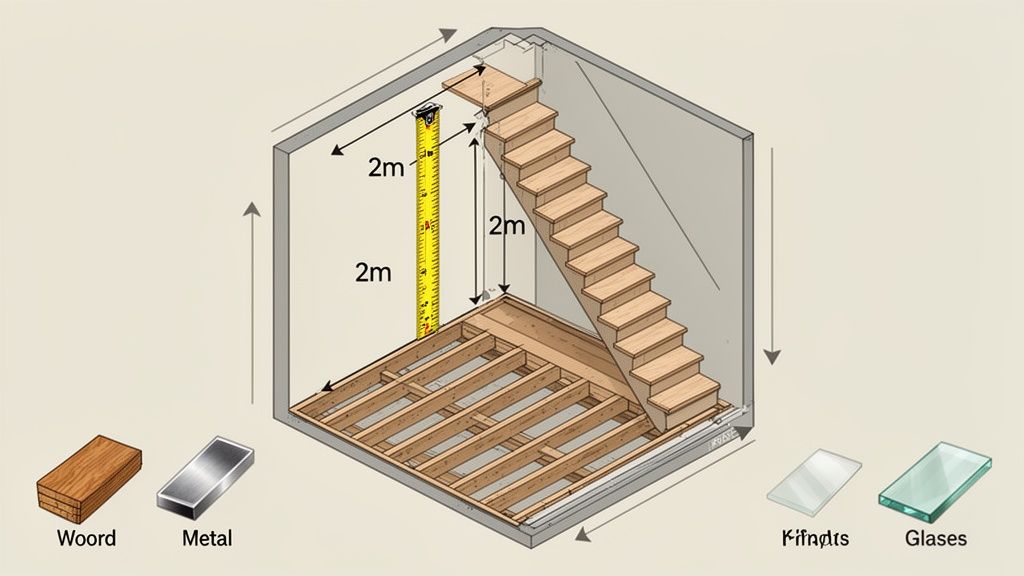
Once you’ve got your head around the regulations and picked a staircase design, it's time to get down to the practicalities of the installation. This is where your project moves from ideas on paper to a solid, actionable plan. A smooth installation really comes down to getting your measurements spot-on, doing robust structural checks, and making smart choices on materials.
Nailing these details early on is the secret to avoiding costly delays and making sure your new space saving loft conversion stairs feel like they've always been a part of your home. Let's walk through the essential steps to create a seamless roadmap, from the initial sketch to the final fitting.
Accurate Measurements and Staircase Location
First things first, you need to decide exactly where the staircase will go. The most logical and space-efficient spot is usually directly above your existing stairs. This creates a natural flow up through the house and minimises the footprint on the floor below—a real win in most London properties.
But is it actually possible? You'll need to get the tape measure out to be sure.
- Floor-to-Floor Height: Measure the vertical distance from the finished floor of the landing below to where the finished floor of the new loft room will be.
- Available Headroom: You need to check the headroom over your current staircase to make sure you can get that required 2 metres of clearance for both the new and old flights. This is a common stumbling block.
- Stairwell Opening: Figure out the size of the opening you’ll need to cut into the loft floor joists. This defines your landing space at the top.
These measurements are the foundation of your plan. They’ll tell you the maximum pitch, length, and width you can get away with, instantly showing which designs are realistic and which are just wishful thinking.
Essential Structural Checks
Before you even think about lifting a floorboard, getting a professional structural assessment is non-negotiable. Your new staircase and the entire loft conversion add a significant new load to your home's structure. On top of that, cutting an opening for the stairs means messing with floor joists, which are critical for supporting the floor above and the ceiling below.
You’ll need a structural engineer or an experienced loft conversion specialist to carry out these checks. They'll assess the existing floor joists to see if they’re strong enough as they are, or if they need beefing up with extra timbers or steel beams (known as trimmers).
Never, ever assume your home’s structure can handle a new staircase without a proper check. A professional assessment is a critical safety measure that protects the integrity of your entire property. An overlooked structural issue can lead to serious, expensive problems down the line.
They will also examine the surrounding walls to confirm they can provide the support needed. This isn't just for peace of mind; it's a mandatory step for getting Building Regulations approval.
Choosing Your Materials
The material you choose for your staircase has a massive impact on its look, durability, and cost. Each one brings a different aesthetic to the table and has its own set of pros and cons.
- Timber: The classic choice. Timber offers a natural warmth and is incredibly versatile. Softwoods like pine are easy on the wallet and can be painted or stained, while hardwoods like oak give you superior durability and a more premium finish.
- Metal: If you're going for a more contemporary or industrial vibe, a metal staircase (usually steel or aluminium) is a fantastic option. They're seriously strong, which allows for slimmer, more open designs that can make a space feel much lighter.
- Glass: Bringing glass into the mix, either for balustrades or even the treads themselves, is a brilliant way to maximise the feeling of light and space. You'll be using toughened, laminated glass for safety, but it does cost more and, let's be honest, needs more cleaning.
Often, the best-looking staircases are a hybrid of materials—think of an oak staircase paired with glass balustrades, blending traditional warmth with a clean, modern feel.
Creating a Realistic Project Timeline
A well-thought-out timeline helps everyone know what to expect and keeps all the different tradespeople coordinated. A staircase installation typically happens during the 'first fix' stage of a loft conversion, after the main structural work is done but before any plastering or decorating begins.
Here’s a rough idea of how it breaks down:
- Structural Work (1-2 weeks): This is when the joists are reinforced and the new stairwell opening is cut.
- Staircase Fitting (2-4 days): The main flight of the staircase is brought in, installed, and secured in place.
- Balustrade and Handrail Installation (1-2 days): All the crucial safety features are fitted.
- Finishing (Variable): Sanding, painting, or varnishing is usually done during the 'second fix' stage, along with all the other decorating jobs.
Don't forget the practical stuff, like site access. Make sure there’s a clear path for the builders to bring in bulky components. The staircase flight often arrives pre-assembled, and it’s bigger than you think! It’s also wise to think about lighting around the new stairwell early on. Planning for a skylight or a few well-placed spotlights can make a massive difference to how the finished space feels.
Budgeting and Finding the Right Contractor
Let's talk about the money side of things. When you're planning for space saving loft conversion stairs, figuring out the costs and finding a professional you can trust are just as vital as picking the perfect design. A solid budget and a reliable contractor are your best defence against headaches and surprise bills down the line.
The final price can swing wildly depending on how complex the staircase is and how much custom work you need. An off-the-shelf kit for a simple, compact flight will always be kinder to your wallet than a fully bespoke spiral staircase made from premium hardwood and glass. It's really important to be realistic about what different solutions actually cost here in the London market.
As you'd expect, costs for different loft conversions vary a lot, and the staircase is a significant slice of that pie. You can get a clearer picture of the investment by checking out the full 2025 loft conversion cost analysis on Resi.co.uk. For builders in premium postcodes like Fulham and Kensington, offering smart, space-saving stair options is a big part of keeping clients happy.
What a Comprehensive Quote Should Include
If a contractor hands you a quote with just a single number on it, that's a massive red flag. A proper, transparent professional will give you a detailed breakdown so you know exactly where every pound is going. This simple step avoids misunderstandings and protects you from those dreaded "surprise" costs later.
Your quote should clearly spell out:
- Materials: The cost of the staircase itself, plus any extra timber, steel, or fixings needed for the structural side of things.
- Labour: The rates for the skilled carpenters, joiners, and builders who will be doing the installation.
- Structural Work: Charges for beefing up joists, cutting the stairwell opening, and any other structural tweaks needed.
- Finishing: Costs for plastering, fitting balustrades, and the initial sanding. Painting or varnishing might be quoted as a separate item.
- Waste Removal: The price for hiring a skip and getting rid of all the building debris responsibly.
- VAT: Make sure it's crystal clear whether VAT is included in the final figure.
This level of detail means you can actually compare quotes from different firms on a like-for-like basis, helping you make a smart decision instead of just picking the cheapest one.
Your Checklist for Hiring the Right Contractor
Honestly, finding a contractor you trust is the single most important decision you'll make. The right team won't just deliver great work; they'll make the whole process smoother with clear communication and professional management.
Your relationship with your contractor is a partnership. Look for someone who listens, provides clear answers, and has a proven track record of successfully completing similar projects in your area. This foundation of trust is invaluable.
Before you sign on the dotted line, use this checklist to vet potential candidates properly. A few straight questions now can save you a world of pain later. For more tips, our guide on how to choose a renovation contractor has some extra pointers.
Here are the key questions you need to be asking:
Can I See Your Insurance?
Ask for proof of Public Liability Insurance. This protects you and your property if something goes wrong. A reputable contractor will have this ready to show you without any fuss.Do You Have References from Recent London Projects?
Don't just take their word for it. Ask to speak with one or two recent clients, ideally in your local area. Ask them about the quality of the work, how the communication was, and whether the job finished on time and on budget.What Is Your Experience with Period Properties?
Working on Victorian or Edwardian homes throws up unique challenges. Your contractor should have specific experience navigating the quirks of older buildings, from wonky floors to delicate original features that need protecting.Who Will Be My Day-to-Day Contact?
Establish who is managing the project on-site and how you’ll get updates. Good communication is absolutely essential. Knowing exactly who to call with a question makes a huge difference to your peace of mind.
Your Loft Conversion Stair Questions Answered
Even with a solid plan in place, it’s completely normal to have a few questions buzzing around before you kick off a project as big as a loft conversion. Most London homeowners I talk to have similar worries, especially when it comes to the fiddly business of fitting a new staircase into an older property.
So, let's get into some of the most common questions we hear. My aim here is to give you clear, straightforward answers that will help you move forward with confidence. Getting these details right from the start can save you a lot of time, prevent expensive mistakes, and make sure your new loft is a safe, fully compliant, and genuinely valuable addition to your home.
Do I Always Need Building Regulations Approval for New Loft Stairs?
Yes, absolutely. If your loft is being turned into a habitable room—like a bedroom, home office, or living space—then getting Building Regulations approval for the staircase is mandatory. This is one part of the process you just can't skip.
The regulations are there for a good reason: to make sure the staircase is structurally sound, safe to use every day, and offers a proper escape route in an emergency. An inspector will check everything from the steepness and headroom to the tread dimensions and handrail security.
Now, if you're just using the loft for storage and access it with a pull-down ladder, the rules are much more relaxed. But any permanent space saving loft conversion stairs leading to a living area must be fully signed off to be legal.
What Is the Narrowest Staircase I Can Legally Install?
This is a great question because it gets right to the heart of balancing space-saving with actual, real-world usability. While UK Building Regulations don't state an absolute minimum width for a secondary staircase in a single home, practicality and safety are what really dictate the limits.
In our experience, 600mm is often seen as the narrowest you can possibly go, but honestly, that can feel incredibly tight. For a staircase you'll be using every single day, we always recommend aiming for 800mm or more if you can spare the space. A staircase that’s too narrow quickly becomes a daily annoyance, making it awkward to get up and down, let alone carry laundry or a piece of furniture. The goal is to find a smart compromise that saves space without killing the functionality of your new room.
The most successful loft conversions are those where the new staircase feels like a natural part of the home, not a compromise. Prioritising comfortable dimensions over saving an extra few inches often pays off in the long run.
Can I Put My New Loft Stairs Over My Existing Staircase?
Stacking your new loft stairs directly above the existing flight is often the most logical and space-efficient layout. It's a popular solution because it creates a natural flow through the house and doesn't steal valuable floor space from a bedroom or landing. It just helps the new addition feel properly integrated, not tacked on.
However, whether this is actually possible in your home comes down to two crucial things: your property's structure and whether you can achieve the required headroom. You absolutely must have at least 2 metres of clear headroom over both the new and the existing staircases. This can be a real challenge in period properties with lower ceilings.
This is not a decision to make based on guesswork. You'll need a structural engineer or an experienced loft conversion specialist to carry out a proper assessment. They’ll be able to tell you if the layout is structurally feasible and if you can meet the headroom rules without anyone having to duck. Only then can you move forward with what is otherwise a brilliant space-saving strategy.
Ready to transform your loft with a staircase that is both beautiful and perfectly suited to your London home? The team at All Well Property Services has the expertise to guide you through every step, from design and compliance to flawless installation. Contact us today for a fixed-price quote and discover your property's true potential.