Side Return Extension Cost London: A Clear Budget Guide for Your Project
So, you're thinking about a side return extension in London? The first question on everyone's mind is always the price. For a typical ground-floor project, you should budget anywhere from £55,000 to over £85,000. The final figure really depends on the size of your space and the quality of the finishes you choose. Still, this gives you a solid ballpark to start your planning.
Your Quick Guide To London Side Return Extension Costs
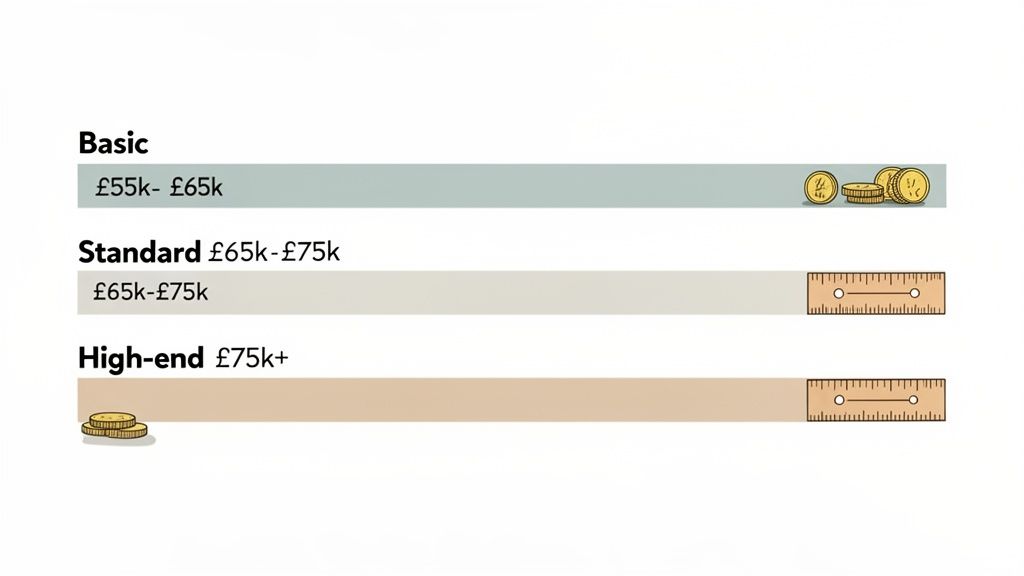
When you're trying to budget for a side return extension, the most practical way to get a handle on the numbers is to think in terms of cost-per-square-metre (£/m²). It’s the metric the pros use, and it helps you compare quotes and see exactly how your choices—from the glazing to the kitchen units—directly affect the final bill.
In London's property market, even a small increase in floor space can completely transform a home's value and how you live in it. A side return is especially smart for Victorian and Edwardian terraces, as it reclaims that often-neglected alleyway. The result? A wider, brighter, and more functional living area, without eating into your precious garden space.
Understanding Cost Tiers
To give you a clearer picture, let's break the costs down into three tiers based on the level of specification you go for. Drawing on 2025 project data, you can expect a basic finish to start from around £2,800–£3,100 per square metre. Standard, mid-range projects usually sit between £3,100–£3,700/m², while premium finishes will push costs well beyond £4,300/m². You can dive deeper into these figures by checking out the real London extension costs gathered by Mayfair Studio.
This tiered pricing structure is really helpful for aligning your ambitions with your budget. The table below gives you a simple framework to see where your project might fit.
A well-executed side return extension is genuinely one of the smartest investments a London homeowner can make. It doesn't just improve daily life by creating a light-filled, open-plan hub; it can also add significant value to your property—often more than the initial outlay.
Estimated Side Return Extension Costs Per Square Metre in London
This table outlines what you can realistically expect to pay per square metre based on the quality of finish you choose. It's a great starting point for your calculations.
Remember, these figures are for the build cost itself. They typically exclude professional fees (like architects and structural engineers) and VAT, which we'll cover later in this guide.
| Specification Level | Average Cost per m² (excl. VAT) | Example 15m² Project Cost (excl. VAT & Fees) |
|---|---|---|
| Basic Finish | £2,800 – £3,100 | £42,000 – £46,500 |
| Standard Finish | £3,100 – £3,700 | £46,500 – £55,500 |
| High-End Finish | £3,700 – £4,300+ | £55,500 – £64,500+ |
As you can see, even for the same 15m² footprint, the difference between a basic job and a high-end one can be over £20,000. This is where your choices on flooring, glazing, and kitchen fittings really start to add up.
Where Does The Money Go? A Detailed Cost Breakdown
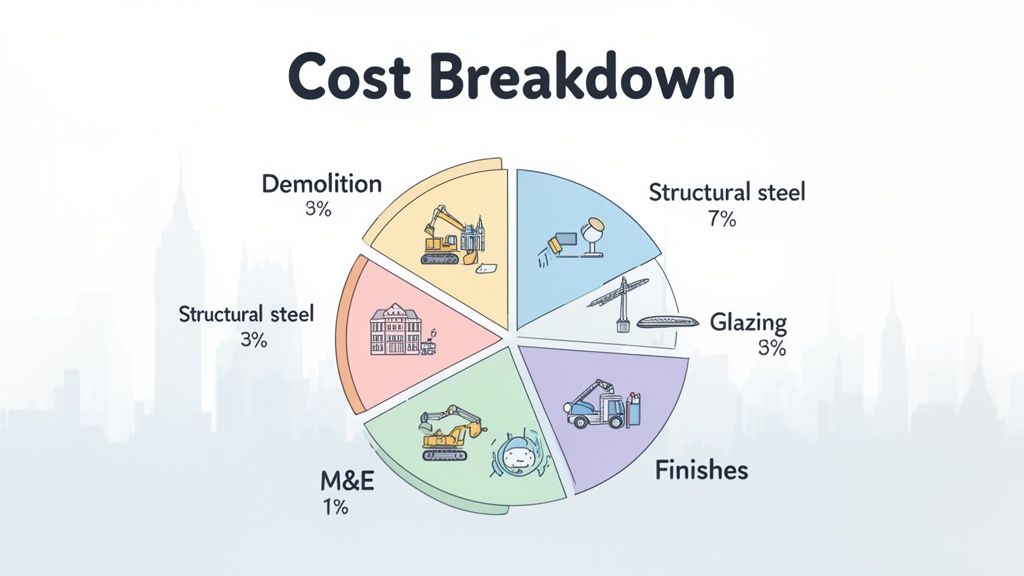
To really get to grips with the total side return extension cost in London, you have to look past the final number on a quote. That figure isn't just pulled out of thin air; it's a careful assembly of materials, labour, and specialist skills. Think of it like a recipe – you need to understand the ingredients to appreciate the final dish.
Every stage of the build, from the first day of digging to the last lick of paint, comes with its own price tag. By understanding how these pieces fit together, you’ll be in a much better position to have clear, productive conversations with your builder and make smarter calls with your budget.
When you get a quote from a builder, it’s useful to see how the costs are allocated across the project. While every job is unique, the percentages tend to fall into a fairly predictable pattern.
Here's a typical breakdown of where the money goes for a side return extension in London.
Typical Cost Allocation For A London Side Return Extension
| Project Phase | Percentage of Budget | Key Activities Included |
|---|---|---|
| Groundworks & Foundations | 15-20% | Demolition, site clearance, excavation, pouring concrete foundations and floor slab. |
| Superstructure (Shell) | 25-30% | Installing structural steel (RSJs), building external and internal walls, constructing the roof frame. |
| External Envelope | 20-25% | Fitting the final roof covering, installing high-performance insulation, fitting windows, skylights, and doors. |
| First & Second Fix Services | 20-25% | Running all plumbing and electrical cables (first fix), then fitting sockets, lights, and radiators (second fix). |
| Internal Finishes | 10-15% | Plastering, laying floors, decorating, and fitting the new kitchen units and appliances. |
This table gives you a solid baseline for understanding your quotes. If you see a quote where one area seems unusually high or low, it’s a good reason to ask your builder for a bit more detail.
H3: The Initial Groundworks Phase
The first real, physical work on your extension is all about preparing the site and laying the foundations. This is the unseen hero of your project, the critical base that ensures the entire structure is stable and will last for decades. A hefty slice of the budget goes right here.
Key jobs during this phase include:
- Demolition and Site Clearance: This means knocking down any existing structures, clearing out plants, and getting the ground ready for what’s to come.
- Excavation: Digging out the trenches for the new foundations. This can get tricky in London due to the wildly varied ground conditions from one street to the next.
- Foundations and Concrete Slab: Pouring the concrete footings and the ground floor slab that will form the base of your new room.
These essential first steps usually account for 15-20% of the total construction cost. If you have poor soil quality or difficult site access for machinery, you can expect this figure to creep up.
H3: Building The Superstructure
Once the foundations are cured, the visible part of the structure starts to climb out of the ground. It’s an exciting time, as you finally see the shell of your new space taking shape. This stage involves some seriously heavy-duty materials and skilled tradespeople.
The structural steel is the skeleton of your new space. It’s what allows for those desirable open-plan layouts and wide expanses of glass. While it represents a significant cost, it's a non-negotiable element for both safety and design freedom.
This stage covers:
- Structural Steelwork: Installing the steel beams (RSJs) needed to support the new structure and hold up the existing house where walls have been removed.
- Brickwork and Blockwork: Building the new external and internal walls that give the extension its shape.
- Roofing Structure: Constructing the timber frame for the roof, whether it’s a modern flat design or a more traditional pitched one.
Together, these core elements can easily make up 25-30% of your total budget. The amount of steel required, in particular, is a major driver of the final side return extension cost London homeowners will pay.
H3: Making It Watertight And Secure
With the main frame up, the next job is to get the extension weatherproofed. This is where you’ll make some of the biggest decisions on glazing, which has a massive impact on both the final cost and the look and feel of the space.
This phase is all about sealing the building's envelope:
- Roof Covering and Insulation: Adding the final layer to the roof—be it tiles, slate, or a modern membrane—and installing high-performance insulation to keep it warm.
- Glazing: Fitting all the windows, skylights, and those big glass doors like bi-folds or sliding systems. Honestly, this is often one of the largest single expenses of the whole project.
This weatherproofing stage, usually dominated by the cost of the glazing, will typically eat up another 20-25% of the construction budget. For example, the price difference between standard UPVC windows and a set of bespoke aluminium sliding doors is enormous and will significantly alter your final bill.
H3: First And Second Fix Services
Now that the shell is secure and dry, the focus shifts inside to install all the essential services that make a house a home. This work is split into two parts: the "first fix," where all the hidden pipes and cables are run, and the "second fix," where the visible fittings are connected.
- First Fix (10-15%): This is all the behind-the-scenes stuff. It includes running plumbing pipes for the kitchen and any new radiators, plus installing all the wiring for sockets, switches, and lighting points.
- Second Fix (10-15%): This is where you see things come to life. It involves connecting radiators, fitting light fixtures, putting on socket faceplates and switches, and plumbing in kitchen appliances.
These services are what make the space functional. A complex lighting design or the need to relocate a boiler will directly affect the labour hours and materials needed, pushing up the cost.
H3: The Finishing Touches
Finally, the project is brought to life by the finishing trades. This is the point where the personality of the space really starts to shine through, and all your design choices become a reality. This last stage covers everything from plastering and flooring to decorating and fitting the kitchen, transforming a building site into a beautiful new part of your home.
Budgeting For Professional Fees And Hidden Costs
The builder's quote is the single biggest figure you’ll see, but it's a huge mistake to think it’s the final number. A truly realistic budget for your side return extension in London has to account for professional fees, council charges, and the unavoidable sting of VAT.
These aren't optional extras; they're the essential costs that make sure your project is legal, safe, and actually well-designed. Forgetting to factor them in is one of the most common traps homeowners fall into, and it can lead to serious financial stress or force you to compromise on the finishes you really wanted.
Your Essential Professional Team
Building an extension isn't a one-person job. You need a team of qualified pros to handle the design, structural integrity, and legal bits. Their fees typically add another 10-15% of the build cost to your total spend.
Architect or Architectural Designer: This is your creative lead. They'll turn your ideas into a workable design, produce the detailed drawings for planning and construction, and help you navigate the maze of regulations. Fees can be a fixed price or a percentage of the build cost, usually between 5-12%.
Structural Engineer: This one’s non-negotiable. They do the maths to figure out the exact structural needs, like the size and type of steel beams (RSJs) required to hold up the new structure and your existing house. You can't get Building Regulations approval without their input. Fees typically range from £1,000 to £2,500+, depending on how complex things get.
Party Wall Surveyor: If your extension is being built right up to or on the boundary with a neighbour, the law says you must serve a Party Wall Notice. If your neighbours don't agree or want their own surveyor, you’ll have to pay for one or even two surveyors to draw up a Party Wall Award. This can cost anywhere from £1,200 to £2,500 per neighbour—a potentially massive expense on a terraced London street.
Navigating Statutory Applications
Before a single shovel hits the ground, you need the green light from your local council. This involves two separate processes, and each has its own fee.
Planning Permission or Lawful Development Certificate:
A lot of side return extensions can be built under Permitted Development rights, which means you can skip a full planning application. However, it's smart to get a Lawful Development Certificate (LDC) to prove the work is legal. That costs about £103 in England. If your project doesn't meet the criteria (for instance, if you're in a conservation area), you'll need a full planning application, which costs £206 for a home extension.
Building Regulations Approval:
This is completely separate from planning. It’s all about health and safety, making sure the build meets standards for structural integrity, fire resistance, and energy efficiency. You’ll submit detailed plans and have inspections at key stages. The application fee, paid to your local council or a private inspector, usually costs between £700 and £1,500.
Remember, the builder’s quote just covers the construction. Professional and statutory fees are separate costs you’ll pay directly to the architect, engineer, and council. Factoring these in from day one is the key to a stress-free project.
The Impact Of VAT
Finally, we get to the biggest "hidden cost" of them all: Value Added Tax (VAT). Most residential building work is subject to the standard VAT rate of 20%. That's a huge addition to your total spend.
You absolutely must clarify with every builder and professional whether their quotes include or exclude VAT. A £60,000 build cost instantly becomes £72,000 once VAT is tacked on. For a deeper dive into financial planning, you can learn more about the hidden costs to watch for in a London home renovation in our detailed guide. Always assume quotes exclude VAT unless it’s stated in black and white. It’s the only way to get a truly accurate picture of your final side return extension cost.
Key Factors That Influence Your Final Project Cost
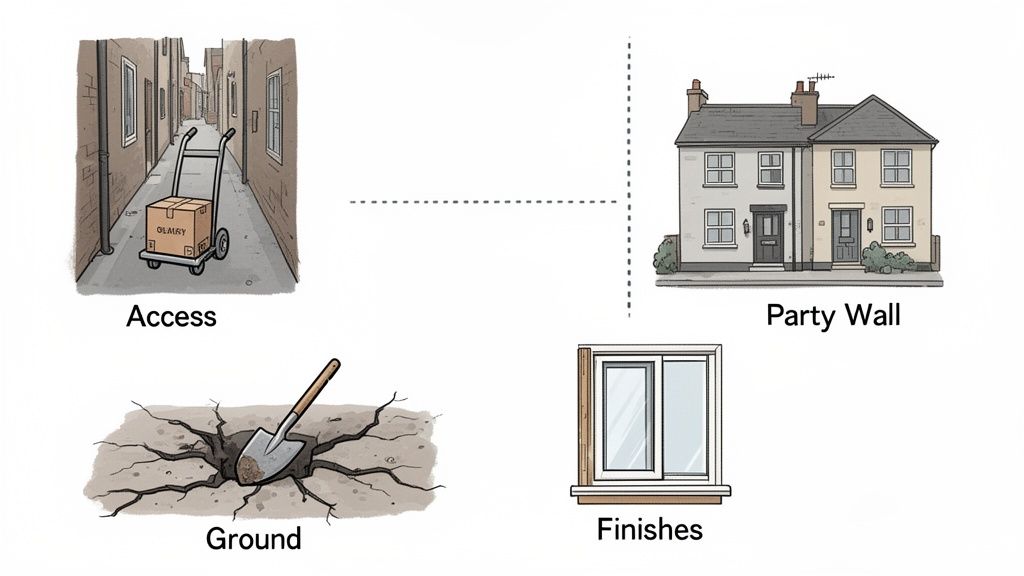
Ever wondered why two side return extensions on the same London street, looking almost identical, end up with completely different price tags? The answer isn't just about the builder you choose. It comes down to a handful of critical variables that can seriously nudge your budget up or down.
An initial quote is just a starting point. The reality of your specific property, the ground beneath it, and the choices you make will ultimately shape the final figure. Getting your head around these factors is the key to creating a realistic budget and avoiding nasty surprises down the line.
Site Access And Logistics
One of the biggest, and most frequently overlooked, cost drivers in London is simply getting people and materials onto the site. Most period terraces have zero rear access, which means absolutely everything – from bags of cement to hefty steel beams – has to be lugged through the house.
This has a direct knock-on effect on your labour bill.
- Manual Labour: Forget mini-diggers for the foundations. Your crew will likely be digging by hand, which is slower and costs more.
- Material Handling: Every single item has to be carefully carried through your home, adding hours to the job and increasing the risk of bumps and scrapes.
- Waste Removal: Skips often can't be placed nearby, meaning all the rubble and waste has to be moved further, again adding to labour time.
A house with decent rear or side access will nearly always come in cheaper than a landlocked terraced home, purely because of these logistical headaches.
Ground Conditions And Foundations
What’s under your house holds a surprising amount of power over your budget. London's geology is a mixed bag, and the ground conditions your neighbour dealt with might be completely different from yours. Clay soil, which is common across the city, is notorious for shrinking and swelling with the seasons, often demanding deeper, more heavily reinforced foundations.
If a structural engineer's survey flags poor ground conditions, you can expect extra costs. This might mean you need engineered foundations like piles or a reinforced raft slab, which are a lot more expensive than standard strip foundations. Even having large trees nearby can complicate things, as their roots can mess with ground stability.
Location And Regulatory Hurdles
Where you live in London makes a huge difference to the overall side return extension cost London homeowners face. It’s not just about what local builders charge; it’s about the red tape you’ll have to navigate.
Being in a Conservation Area doesn't mean you can't build an extension, but it does mean you'll face stricter rules. The council will likely dictate the use of specific materials—like reclaimed London stock bricks or slate roof tiles—to match the area's character, which are often more expensive than modern alternatives.
On top of that, the Party Wall Act is a major consideration for anyone in a terraced or semi-detached property. With neighbours on both sides, you could be looking at arranging two separate Party Wall Awards. This process involves specialist surveyors and can easily add a few thousand pounds to your professional fees before a single brick is laid. If you're weighing up your options, it can be helpful to learn more about side return vs rear extensions in our guide.
Structural Complexity And Design Ambition
The amount of structural work involved is a primary cost driver. That dream of a huge, open-plan kitchen-diner with no columns in sight? It relies on some serious structural steel beams (RSJs). The more walls you knock down and the wider the opening you create, the bigger and pricier that steelwork gets.
Likewise, ambitious design choices like a fully glazed roof or a cantilevered 'floating' corner will require complex engineering and specialist fitters, both of which add a hefty sum to the bill. These features look incredible, but they represent a significant jump in cost compared to more straightforward designs.
Specification And Final Finishes
Finally, we get to the part you have the most control over: your choice of finishes and fittings. This is where you can really steer the budget. The gap between a basic, mid-range, and high-end finish is massive, and it touches everything from the kitchen taps to the flooring.
For instance, average build costs in Central London hover around £3,000 plus VAT per square metre, but this can easily climb past £3,500 per m² for projects with luxury finishes, lots of architectural glazing, and high-end fixtures.
Think about these key trade-offs:
- Glazing: Standard uPVC bi-fold doors can be tens of thousands of pounds cheaper than a set of super-slimline aluminium sliders.
- Kitchen: A flat-pack kitchen from a high-street supplier is a fraction of the price of a bespoke, handmade kitchen with stone worktops.
- Flooring: Opting for luxury vinyl tile (LVT) instead of engineered oak or polished concrete can save you thousands.
Every decision you make on the final look and feel of your space is a lever you can pull to manage your total project cost.
Three Realistic London Extension Budget Examples
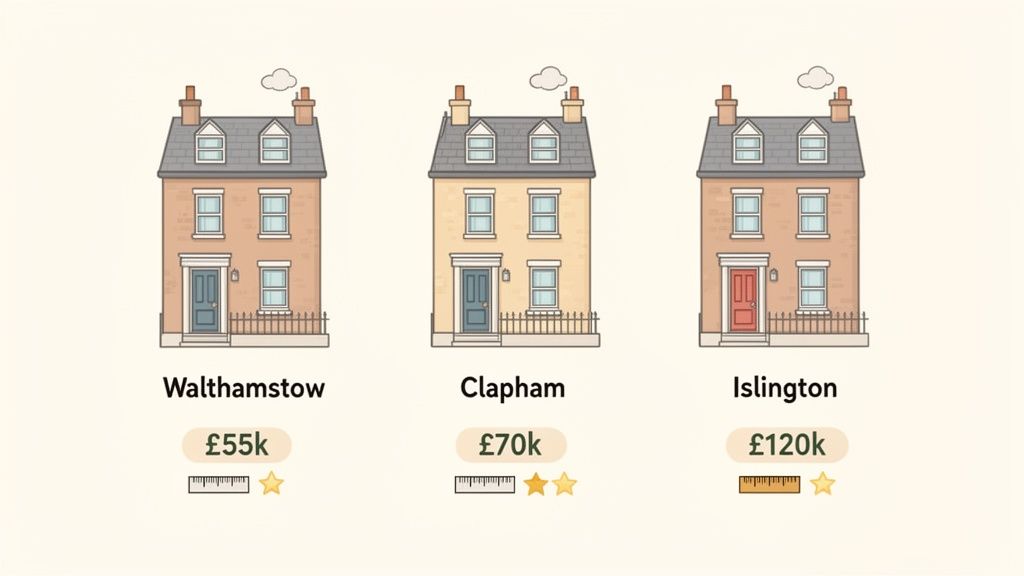
Abstract figures and per-square-metre rates are useful starting points, but nothing brings the side return extension cost London homeowners face to life like real-world examples. To help you benchmark your own project, we've pulled together three realistic budget scenarios based on typical London properties.
These examples show how size, location, and your choice of finishes create vastly different financial outcomes. We’ll walk through a compact, budget-conscious project in an area like Walthamstow, a mid-range extension in Clapham, and a high-specification build in a prime borough like Islington. Each scenario gives you a full cost breakdown, including the build, professional fees, and the all-important VAT.
Example 1: The Compact Walthamstow Infill
Our first scenario is a small infill extension on a Victorian terrace in Walthamstow, a popular spot for young families. The goal here is getting maximum impact on a tighter budget, focusing on a brighter, more functional kitchen-diner without overspending.
- Project Size: A modest 12 square metres.
- Scope of Work: Infilling the side return with a simple flat roof and two standard skylights. It includes mid-range aluminium bi-fold doors, a quality kitchen from a high-street supplier, and durable luxury vinyl tile (LVT) flooring. The focus is on getting the core structure right and finishing it cleanly.
- Build Cost (Excl. VAT): At a practical rate of £3,200/m², the build cost comes to £38,400.
- Professional Fees: Budgeting around 12% for an architect, structural engineer, and council fees adds approximately £4,600.
- Subtotal: This brings the pre-VAT total to £43,000.
- VAT at 20%: Adds a significant £8,600.
- Estimated Total Cost: £51,600.
Example 2: The Standard Clapham Family Extension
Next, let's head to a classic family home in Clapham. This project is larger and has a more generous specification, reflecting a desire for a quality open-plan living space that will be the heart of the home for years.
- Project Size: A standard 18 square metres.
- Scope of Work: This involves creating a wider opening into the house, which needs more structural steel. It includes a partially glazed roof, higher-spec slimline sliding doors, underfloor heating, and an upgraded kitchen with quartz worktops. Finishes are a step up across the board.
- Build Cost (Excl. VAT): With a higher specification, the build rate is around £3,700/m², leading to a build cost of £66,600.
- Professional Fees: At 12%, fees for the larger, more complex design are around £8,000. This also includes a Party Wall Award for one neighbour.
- Subtotal: The total before VAT is £74,600.
- VAT at 20%: The tax bill comes to £14,920.
- Estimated Total Cost: £89,520.
For many London projects, the all-in cost for a full side return, once construction, VAT, and professional fees are tallied, often settles between £150,000 and £300,000, depending heavily on size and the quality of the fit-out. As one London architectural firm notes, a typical 12m² side return might have a build cost around £60,000, but this can quickly escalate with high-end finishes and extensive internal refurbishments. Discover more insights on how a side return extension cost is calculated in London.
Example 3: The High-Specification Islington Project
Our final scenario is a premium extension in a conservation area in Islington. The budget here has to accommodate architectural ambition, bespoke features, and the extra costs that come with planning constraints and a prime London postcode.
- Project Size: An expansive 22 square metres.
- Scope of Work: This is a top-tier project featuring a structural glass roof, bespoke joinery, and a 'frameless' corner with large sliding doors. It requires reclaimed London stock bricks to meet conservation area rules. The kitchen is custom-made, floors are polished concrete, and a high-end lighting scheme is installed.
- Build Cost (Excl. VAT): The premium rate for this level of work is £4,500/m², resulting in a build cost of £99,000.
- Professional Fees: Complex design, tricky planning negotiations, and Party Wall Awards with two neighbours push fees to 15%, totalling around £14,850.
- Subtotal: This makes the pre-VAT figure £113,850.
- VAT at 20%: Adds another £22,770.
- Estimated Total Cost: £136,620.
These examples clearly show there is no single answer to the side return extension cost London question. Your final spend will be a direct reflection of your home's location, your design choices, and the quality of the finish you want to achieve.
How To Get Accurate Quotes And Maximise Your Investment
Navigating the final stages of your project is all about making smart, informed decisions. Getting accurate quotes isn't just a race to the bottom on price; it's about finding the best value and making sure there are no nasty surprises waiting for you down the line. A vague request will only ever get you a vague, unreliable estimate.
The bedrock of any solid quote is a detailed set of architectural drawings and a comprehensive specification document. This document, often called a 'scope of works', is your project's rulebook. It lists everything from the exact type of bricks and window frames to the specific model of kitchen taps you've set your heart on. Without this level of detail, builders are left to guess, and their quotes will be impossible to compare properly.
Handing three different builders the same detailed plans and specification is like giving three chefs the exact same recipe. You can then confidently compare their prices for the same end result, ensuring a true like-for-like assessment of the side return extension cost London builders will offer.
Vetting Builders And Understanding Quotes
Once your detailed documents are ready, it’s time to find the right team for the job. You’ll want to get quotes from at least three reputable contractors. This gives you a clear sense of the going market rate and helps you spot any quotes that seem way off the mark—either too high or too low.
When the quotes land in your inbox, resist the urge to immediately jump at the lowest number. A suspiciously cheap bid can be a massive red flag. It might mean the builder has missed something crucial, is planning to use subpar materials, or intends to sting you with extra costs later on. It's vital to choose a team you can trust; you can get more insight by reading about choosing the right renovation contractor in London.
Always push for a fixed-price contract. This kind of agreement locks in the cost for the specified work, giving you peace of mind and protecting you from unexpected price hikes.
Maximising Your Return On Investment
A well-executed side return extension is more than just a lifestyle upgrade; it’s a seriously sound financial move. In London's fiercely competitive property market, creating a bright, open-plan kitchen-diner is one of the most effective ways to add significant value to your home.
Estate agents will tell you time and again that a high-quality kitchen extension can boost a property's value by as much as 20%. In many cases, this means the project doesn't just pay for itself but actually generates a substantial return.
By focusing on quality design, durable materials, and a layout that maximises light and flow, you’re not just spending money—you’re investing it directly back into your most valuable asset. The result is a home that’s a joy to live in and a far more attractive prospect for any future buyers.
Frequently Asked Questions
Even with a detailed guide, it’s completely normal to have a few questions rattling around when you’re planning something this big. Here are the most common queries we get from London homeowners, with some straight-talking answers to help you get moving.
How Long Does a Side Return Extension Take from Start to Finish?
You’ll need a bit of patience for this one. While the actual building work on site might only last 12 to 16 weeks, that’s just the final sprint. The whole marathon, from your first chat with an architect to putting the kettle on in your new kitchen, usually takes somewhere between six and nine months.
So, where does all that extra time go? It’s soaked up by the crucial prep stages that happen long before a single brick is laid:
- Design Phase (4-8 weeks): This is where you and your architect hash out the plans and get them just right.
- Planning/LDC Application (8-10 weeks): You’re in the hands of the local council here, and waiting for their decision takes time.
- Party Wall Agreements (2-8 weeks, but can be longer): A legal must-have that can really drag its heels if your neighbours don't agree straight away.
- Finding a Builder (4-6 weeks): Good builders are often booked up, so you’ll need time to vet them and wait for a slot to open up.
Thinking about the project in these stages helps manage expectations and keeps the frustration at bay.
Do I Need Planning Permission for a Side Return?
Not always, which is fantastic news for a lot of people. Many single-storey side return extensions fall under what’s known as Permitted Development Rights (PDR), letting you skip a full-blown planning application.
But—and it's a big but—there are strict rules. The extension can’t be higher than four metres or wider than half the original house width, for a start. Crucially, PDR doesn't apply to flats or maisonettes, and councils often remove these rights in Conservation Areas.
Even if you tick all the boxes, we strongly advise getting a Lawful Development Certificate (LDC) from your council. It’s official proof that your build is legal, which you’ll absolutely need when it comes time to sell.
Think of a Lawful Development Certificate as an insurance policy for your extension. It provides official confirmation that the work was compliant from the outset, preventing any legal headaches or issues with future buyers down the road.
Will a Side Return Extension Add Value to My Property?
Yes, absolutely. A well-designed side return is one of the smartest home improvements you can make, especially in the fiercely competitive London property market. Estate agents consistently report that a high-quality kitchen-diner extension can boost a property's value by as much as 20%.
The secret is creating that bright, open, and super-functional space that today’s buyers are desperate for. When you swap a cramped galley kitchen for a spacious family hub that flows into the garden, you’re not just improving your home; you’re massively increasing its appeal.
In many London postcodes, the value added will comfortably exceed the total side return extension cost London homeowners invest, making it a sound financial move as well as a brilliant lifestyle upgrade.
Ready to transform your home with a stunning, high-quality extension? The team at All Well Property Services offers expert project management, fixed-price quotes, and a commitment to exceptional craftsmanship across London. Start your renovation journey with us today.