Discover kitchen renovation cost london: A Complete Guide
So, what does a kitchen renovation cost in London? Realistically, you’re looking at a starting point of around £10,000 for a budget-friendly refresh, but that figure can easily climb past £75,000 for a high-end, bespoke project.
Most London homeowners find themselves somewhere in the middle, with mid-range renovations typically landing between £20,000 and £35,000. These prices aren't just numbers plucked from thin air; they reflect the capital's premium on skilled labour and quality materials.
Your Quick Guide to London Kitchen Renovation Costs

Starting a kitchen renovation is one of the most rewarding upgrades you can make to your home. It’s your chance to create a space that truly fits how you live, whether you're a serious home cook, a busy parent juggling school runs, or someone who loves having people over.
But let's be honest, the first question on every Londoner's mind is always the same: what's this actually going to cost me?
Getting a firm grip on the finances from day one is absolutely crucial for a smooth project. Without a realistic budget, it’s far too easy to feel overwhelmed or get hit with unexpected bills down the line. Think of this guide as your financial starting line—a way to frame your project's scope before you get lost in the finer details of worktops and tile choices.
Here at All Well Property Services, we specialise in navigating these costs to deliver brilliant value and total transparency. We’ve seen it all, from compact flats in Fulham to spacious period homes in Clapham, and we understand the unique challenges that come with renovating in London. Our whole goal is to demystify the process, helping you make smart, informed decisions every step of the way.
To give you a clearer picture from the outset, here’s a quick summary of what to expect.
At-a-Glance Kitchen Renovation Costs in London
| Project Tier | Typical Price Range (London) | Key Features Included |
|---|---|---|
| Budget Refresh | £10,000 – £18,000 | Off-the-shelf units, laminate worktops, basic appliances, simple re-tiling and decorating. No major layout changes. |
| Mid-Range Renovation | £20,000 – £35,000 | Semi-custom units, composite or solid wood worktops, integrated appliances, new flooring, and minor electrical/plumbing work. |
| High-End / Bespoke | £40,000 – £75,000+ | Bespoke cabinetry, stone or high-end composite worktops, premium appliances, underfloor heating, structural changes, and full redesign. |
These figures provide a solid baseline for planning your kitchen project in the capital. Now, let’s dig into why London prices are what they are.
The London Premium Explained
It’s no secret that pretty much everything costs more in the capital, and home renovations are no exception. The "London premium" isn't just a myth; it's a real factor that directly impacts your final bill. Homeowners here can expect to pay anywhere from 15-25% more for their kitchen renovation compared to other parts of the UK.
So, where does this extra cost actually come from? It boils down to a few key things:
- Higher Labour Rates: Skilled tradespeople—from kitchen fitters to electricians and plumbers—command higher daily rates in London simply because the cost of living is so much higher.
- Logistical Headaches: Trying to navigate congested streets, dealing with parking restrictions, and managing deliveries to a terraced house with limited access all add time, complexity, and cost to a project.
- Property Values: With property values soaring in areas like Kensington and Balham, there’s a much higher demand for premium materials and high-specification finishes, which naturally pushes up the average project cost.
This premium is something you absolutely have to factor into your initial budget. While an average UK kitchen renovation might range from £10,000 to £25,000, Londoners often find their projects starting at the higher end of that scale. For example, a basic refresh that might cost £3,000-£7,000 elsewhere will be considerably more in the city. You can get a better sense of these national averages and see just how the London market compares.
Where Does Your Renovation Budget Actually Go?
When you get a quote for your dream kitchen, it's easy to just see one big number. But that single figure is a complex puzzle made up of dozens of individual pieces, each with its own cost. Getting your head around how this puzzle fits together is the secret to keeping your budget in check and making smart decisions about your kitchen renovation cost in London.
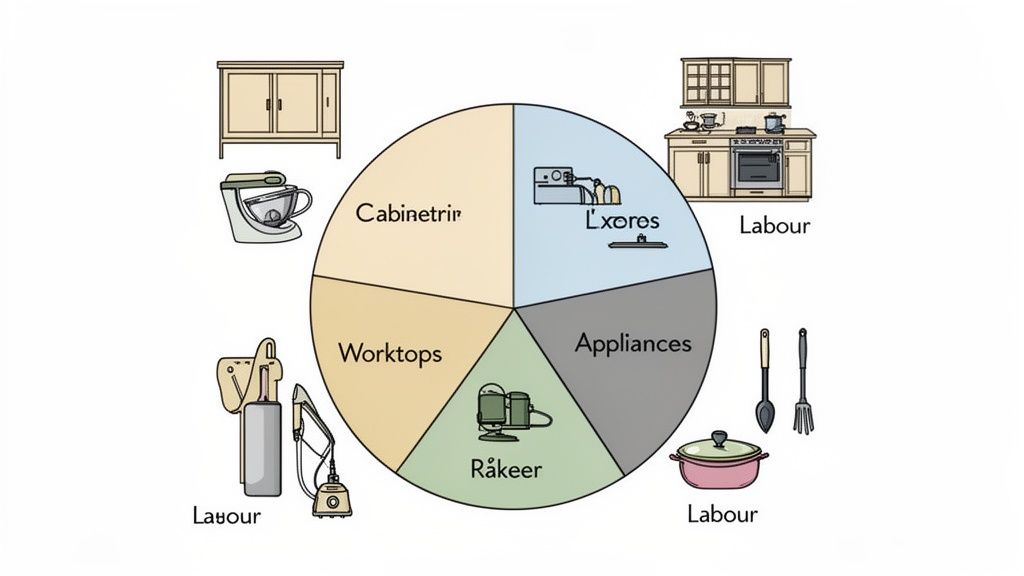
Think of your total budget as a pie. Each slice represents a different part of the project—cabinets, worktops, appliances, and the crucial labour to fit it all. The size of those slices can change a lot depending on your choices, but knowing the typical proportions helps you plan where your money should go from the start.
This is even more important in London, where skilled trades are in high demand and period properties love to throw a few curveballs your way. At All Well Property Services, we're all about total transparency, so you know exactly where every pound is going and why each bit matters.
The Big Four: Where Your Money Is Spent
Your kitchen budget mostly splits four ways. While the percentages can shift about, these core elements are pretty much the same for every job. Understanding them gives you the power to decide where to splash out and where you might be able to save.
Here’s the typical breakdown:
- Cabinetry and Units: This is often the biggest material expense, eating up 30-40% of your total budget. It covers everything from the basic carcasses to the door fronts, handles, and clever internal storage.
- Worktops: A highly variable but major cost, usually taking 10-20% of the pie. Your choice of material here—from affordable laminate to premium marble—is one of the single biggest things that can swing your final price.
- Appliances: This slice typically lands between 10-15%. It includes your oven, hob, extractor, fridge-freezer, and dishwasher. Go for high-end, integrated models, and this percentage can easily climb higher.
- Labour and Installation: This is the engine room of your budget, often accounting for a hefty 30-50% of the total spend. This covers the skilled work of the fitters, electricians, plumbers, tilers, and decorators who bring it all to life.
Knowing this balance helps you see why a "cheap" kitchen isn't always cheap once you factor in the fitting. The initial cost of the units might be low, but the skilled labour needed to make them fit perfectly in an uneven Victorian terrace stays the same.
Why Skilled Labour is a Non-Negotiable Investment
In the world of London property renovations, it’s tempting to try and shave costs on labour. Honestly, this is almost always a false economy. The quality of the installation is what separates a good kitchen from a great one that will actually last.
A beautifully designed kitchen with premium materials can be completely undermined by poor installation. Expert fitting ensures perfect alignment, secure fixtures, and flawless finishing, protecting your investment for years to come.
A skilled kitchen fitter does more than just screw boxes together. In London, they are problem-solvers, brilliant at scribing units to fit wonky walls, navigating tangled plumbing in older buildings, and getting every single detail spot-on. That expertise costs money.
Labour is often the biggest single factor in UK kitchen renovations, potentially making up 50% of the final bill. London kitchen fitters typically charge between £250-£350 per day. With a standard project lasting 4-6 weeks, this can quickly push a mid-range job into the £12,000-£18,000 bracket for labour alone. You can find more details in this Checkatrade breakdown of renovation expenses.
How Material Choices Can Dramatically Swing the Final Price
While labour is a huge chunk, your choice of materials is where you have the most power to steer the budget. The difference between a budget-friendly finish and a luxury one can be absolutely massive.
Let's just take the worktop as an example.
- Laminate Worktops: A practical and stylish option, often costing between £50-£100 per linear metre.
- Solid Wood Worktops: Adds natural warmth for around £100-£250 per linear metre.
- Quartz Worktops: A durable and hugely popular choice, typically priced from £300-£500 per linear metre.
- Marble or Granite: A premium, high-end material that can easily shoot past £500-£800 per linear metre.
For a medium-sized kitchen needing five metres of worktop, this decision alone could be the difference between spending £500 and spending £4,000. The same logic applies to cabinets (flat-pack vs. bespoke), flooring (vinyl vs. engineered oak), and tiles (ceramic vs. handcrafted porcelain). Every choice builds on the last, shaping the final kitchen renovation cost in London. This is where professional guidance really helps, making sure you invest where it counts most.
The Investment Behind a Bespoke London Kitchen
When you step into the world of bespoke kitchen design, you’re not just picking out nice materials; you’re commissioning a piece of living art. This is a world away from standard layouts and off-the-shelf units. We're talking about pure craftsmanship, custom joinery, and intelligent design that genuinely reshapes your home.
This is where the true potential of your property gets unlocked. It’s an investment in a space planned meticulously around your lifestyle, tailored to the unique architectural bones of your London home, and built to a standard that high-street kitchens simply can't touch. If you've got a vision for something truly exceptional, understanding the costs involved is the first step toward making it happen.
The final figure for a high-end kitchen renovation cost in London is a direct reflection of this customisation and quality. Every single element, from the hand-painted cabinetry to the vein-matched marble worktops, is chosen and crafted for a specific purpose.
What Defines a High-End Kitchen Renovation
A bespoke kitchen project isn't just about the price tag; it's defined by a total commitment to detail and quality at every turn. It’s a holistic approach where every component is considered not just for its function, but for how it contributes to the overall feel of the space.
Several key elements elevate a project into this premium category:
- Custom-Made Cabinetry: This is the heart of any bespoke kitchen. Instead of being stuck with standard sizes, units are built to the exact dimensions of your room. This maximises storage and creates seamless, beautiful lines. The materials are also superior—think solid wood frames and specialist, hand-applied finishes.
- Premium Worktop Materials: Surfaces like natural marble, high-grade quartz, or incredibly durable sintered stone are the hallmarks of a luxury kitchen. These materials offer unique beauty and longevity but require specialist fabrication and installation, which adds to the cost.
- High-Specification Integrated Appliances: Top-tier brands like Miele, Gaggenau, or Sub-Zero are often the go-to choices for their performance and reliability. They’re also designed to integrate flawlessly into the cabinetry for that clean, uncluttered look.
- Intelligent Lighting and Technology: A sophisticated lighting scheme is crucial. We’re talking about everything from task lighting under cabinets to statement pendant lights. Smart home integration for appliances and lighting is also becoming a common feature in these high-end projects.
The Costs of Craftsmanship and Structural Work
Achieving a truly bespoke finish often involves more than just cosmetic upgrades. Many high-end London renovations, especially in period properties, require significant structural work to create the open-plan layouts that modern living demands. This is a major factor driving the overall cost.
Knocking down walls, installing steel beams (RSJs), and extending the property are common parts of these jobs. Each of these steps requires architectural plans, structural engineering calculations, and sign-off from Building Control—all of which add professional fees to the budget.
A high-end kitchen isn't just an installation; it's a construction project. The investment reflects the complexity of merging bespoke craftsmanship with the structural and technical demands of modernising a London home.
High-end kitchen renovations in London frequently start above £25,000 and can easily sail past £60,000 for these kinds of bespoke designs. Recent trends show that 51% of homeowners are choosing to enlarge their spaces, which can add over £5,000 just for the structural changes and Building Regulations compliance. Premium materials elevate the cost further; marble worktops can run from £400-£1,000 per metre, while integrated appliances and smart lighting push the average towards £35,000. You can discover more insights about these premium kitchen costs and homeowner trends.
At All Well Property Services, we manage these complex projects from the ground up. Our team is particularly skilled at handling the structural alterations common in London's Victorian and Edwardian homes, ensuring the foundation of your new kitchen is as solid as its beautiful finish. By overseeing every detail, from planning applications to the final coat of paint, we provide a seamless experience that protects your investment and delivers a stunning result that significantly boosts your property’s value.
Planning for the Costs You Can't See

Here’s a truth every seasoned renovator knows: the most successful projects are the ones that plan for the unexpected. It’s easy to get caught up budgeting for beautiful worktops and shiny new appliances, but it's the costs you can't see that pose the biggest threat to your timeline and your wallet. These are the details that can turn a smooth project into a stressful mess if you haven't prepared for them.
Think of your main budget as the planned journey and these potential extra costs as the travel insurance. You really hope you won't need it, but you'll be incredibly relieved it's there if something goes wrong. This is especially true when renovating London's older properties, which are notorious for hiding secrets behind their walls.
At All Well Property Services, we build trust by being upfront from day one. By shining a light on these potential hidden costs from the outset, we help you create a robust, realistic budget that protects you from nasty surprises down the road.
Uncovering Common Hidden Expenses
Beyond the big-ticket items like cabinetry and labour, several smaller—but significant—costs must be factored into your total kitchen renovation cost in London. Forgetting these can leave you with a budget shortfall just when you need the funds most.
Before we dive into what might be lurking behind your walls, let's talk about the more predictable costs that often get missed. Forgetting these can quickly eat into your budget.
This checklist covers some of the most common oversights we see.
Checklist of Potential Hidden Renovation Costs
| Expense Category | Typical Cost Estimate (London) | Why It's Important |
|---|---|---|
| VAT | 20% of total cost | Always check if quotes include VAT. An unexpected 20% on top of your final bill is a significant hit. |
| Skip Hire & Waste Removal | £200 – £450+ per skip | Ripping out an old kitchen creates a huge amount of waste. You'll likely need at least one skip, plus permits. |
| Contractor Parking & Permits | £10 – £50 per day | If you're in a controlled parking zone, you'll need to cover daily permits for your build team's vehicles. |
| Professional Fees | £1,500 – £5,000+ | For structural changes, you'll need an architect, structural engineer, and possibly a party wall surveyor. |
| Making Good | £500 – £2,000+ | After trades like electricians and plumbers finish, you'll need a plasterer and decorator to repair walls and ceilings. |
| Temporary Kitchen Setup | £200 – £800 | Budget for a microwave, mini-fridge, and increased takeaway costs while your kitchen is out of action. |
This isn't an exhaustive list, but it highlights how easily smaller costs can accumulate. For a deeper dive, it's worth exploring our guide on the hidden costs to watch for in a London home renovation.
The Surprises Lurking in London Properties
London's housing stock, particularly its charming Victorian and Edwardian terraces, adds another layer of complexity. These period properties can conceal issues that only come to light once the work has started.
Your contingency fund is your project's single best insurance policy. A buffer of 10-15% is the industry standard and provides the financial flexibility to handle unforeseen issues without compromising on the quality of your finished kitchen.
Common surprises we run into include outdated wiring that doesn't meet current safety regulations, old lead pipes that need replacing, or patches of hidden damp behind old units that must be treated. Discovering these issues mid-project can halt progress and add unexpected costs for specialist trades.
This is precisely why a contingency fund is non-negotiable. Setting aside an extra 15% of your total budget gives you a crucial safety net. If you don't use it, you have a bonus for upgrading an appliance or splurging on finishes. If you do need it, you can address the problem properly without derailing your entire renovation. A good contractor will always advise this, providing a comprehensive, fixed quote that clearly outlines what's covered and anticipates potential variables, ensuring you stay in control.
How to Save Money Without Sacrificing Quality
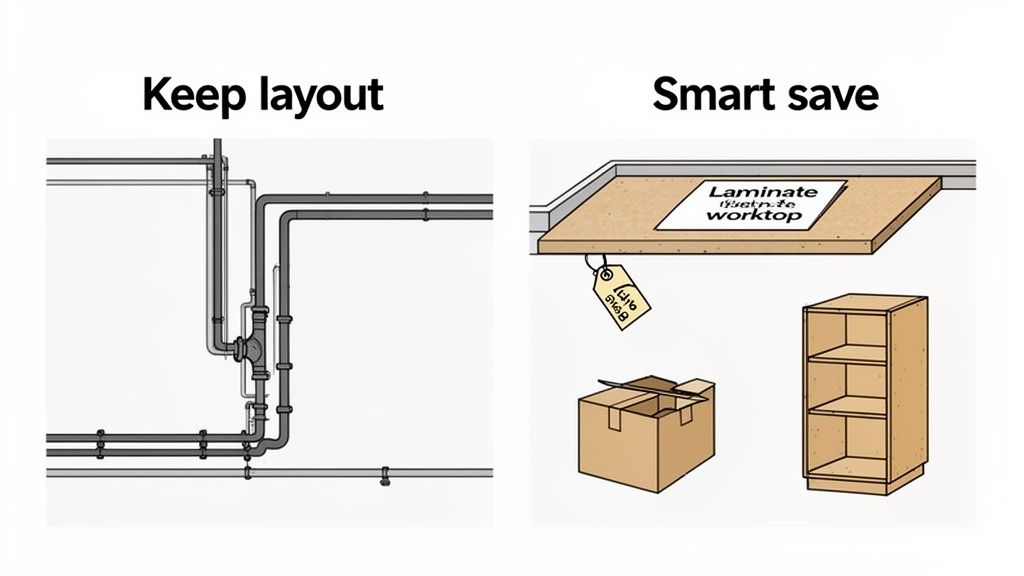
A smart renovation isn't about chasing the absolute rock-bottom quote; it's about making savvy decisions that deliver fantastic value for years to come. Bringing down your kitchen renovation cost in London doesn't mean settling for a space you don't love. It’s all about being strategic—knowing where to invest for maximum impact and where clever compromises can save you thousands without anyone ever noticing.
With a bit of thought, you can stretch your budget much further than you might think. The key is to focus on practical strategies that prioritise durability and function while being smart about the aesthetics. This section is packed with actionable tips to help you get a beautiful, lasting kitchen without the eye-watering bill.
Keep Your Layout and Keep Your Cash
The single most effective way to keep your renovation budget in check is to work with the layout you've already got. Moving plumbing, gas lines, and electrical sockets is one of the fastest ways to see costs spiral. It involves a whole team of tradespeople—plumbers, electricians, plasterers—and adds a significant amount of time to the project.
By keeping your sink, cooker, and major appliances roughly where they are, you can save thousands of pounds. That money can then be funnelled into the areas that give you more visual bang for your buck, like higher-quality worktops or more durable cabinet fronts.
A common mistake is assuming you need a huge extension or a massive reconfiguration to get the kitchen you want. Often, clever design within the existing four walls can achieve your goals for a fraction of the cost and disruption.
Think of it as working with your home, not fighting against it. This one decision minimises complex structural and service changes, keeping your costs predictable and your project on schedule. If you are struggling with a smaller space, you can find inspiration in our guide on clever ideas for maximizing storage in a small kitchen.
Make Smart Material and Unit Choices
Your choice of materials is where you have the most direct control over the final bill. This is your chance to mix and match to create a high-end look on a much more sensible budget.
Here are a few proven strategies for making smart substitutions:
- Worktops Wisely: While stone is beautiful, modern high-quality laminates offer incredible realism. A good stone-effect laminate can give you the desired look for as little as £50 per metre, compared to £400+ per metre for quartz. This choice alone can save you a huge sum.
- Embrace Professional Flat-Pack Assembly: Bespoke joinery is a major expense. High-quality flat-pack kitchen units from reputable suppliers can be an excellent middle ground. The secret is professional assembly—a skilled fitter can make standard units look custom-built, ensuring perfect alignment and a durable finish.
- Prioritise Durability Where It Counts: It really pays to splurge on the things that take the most daily punishment. Invest in durable worktops, quality taps, and robust drawer runners. You can then save on things like decorative handles or splashback tiles, which can be easily and inexpensively upgraded down the line.
A Strategic Approach to Appliances and Labour
Finally, think carefully about how you allocate funds for appliances and labour. Not everything needs to be brand new or top-of-the-range.
- Reuse and Recycle Appliances: If your current oven, hob, or fridge-freezer is in good working order and fits the new design, there's no rule saying you must replace it. Reusing reliable appliances is an instant and substantial saving.
- Shop for Ex-Display Models: Keep an eye out for sales at kitchen showrooms. You can often find high-end, ex-display appliances at a fraction of their retail price, allowing you to get premium brands within a mid-range budget.
- Bundle Your Trades: Whenever you can, use a single contractor like All Well Property Services who can manage all the required trades. This is often more cost-effective than hiring individual plumbers, electricians, and tilers, and it streamlines project management, reducing the risk of costly delays.
Achieving Peace of Mind with a Fixed-Price Quote
Navigating the costs of a kitchen renovation in London can feel a bit overwhelming. With so many moving parts—from picking materials to discovering unexpected structural issues—the fear of your budget spiralling out of control is a real concern for homeowners across the capital.
But that kind of uncertainty doesn't have to be part of your renovation story. The alternative is a process built on clarity and trust, where the price you’re quoted is the price you actually pay. This is the whole idea behind a fixed-price quote, an approach that gives you complete financial peace of mind from day one.
At All Well Property Services, we firmly believe that a smooth renovation is a predictable one. Our commitment to fixed-price quotes is how we turn a potentially stressful project into a properly managed, seamless experience.
How a Fixed Quote Protects Your Investment
A fixed quote isn't just a number; it's a promise. It represents a detailed, comprehensive assessment of every single aspect of your project before any work kicks off. This diligence means we account for absolutely everything, from hiring the skip and sorting parking permits right down to the final coat of paint.
For you, this means no hidden fees or surprise invoices. The price is agreed upon upfront, letting you budget with total confidence. This approach is especially crucial in South West London, where period properties can often hide costly little surprises. Our experience means we can anticipate these challenges and build them into a transparent, all-inclusive plan.
A fixed-price quote shifts the financial risk from you, the homeowner, to the contractor. It’s a clear sign of a company's confidence in their process, their team, and their ability to deliver exactly what was promised, on time and on budget.
This method is backed by diligent project management and clear, daily communication, keeping you in the loop every step of the way. When you’re choosing a renovation partner, it’s vital to understand how they handle their quoting and project management. You can learn more about what to look for when you choose a renovation contractor to make sure your project is in safe hands.
Our team of certified tradespeople respects your home’s unique character, ensuring every detail is handled with genuine care. This meticulous approach is what separates a chaotic build from a high-quality transformation delivered with professionalism and predictability. It’s how we ensure your vision becomes a reality, without the financial anxiety.
Frequently Asked Questions About London Kitchen Renovations
Getting into the details of a kitchen remodel always brings up plenty of questions. Here are some straightforward answers to the queries we hear most often from London homeowners, designed to give you a clearer picture of the process and help you plan with confidence.
How Long Does a Typical Kitchen Renovation Take in London?
For a standard kitchen renovation in London—stripping out the old and fitting the new, without any major structural changes—you're typically looking at somewhere between two to four weeks. This covers everything from the first-fix electrics and plumbing right through to installing the units, decorating, and final sign-offs.
However, if your project is more complex, things can stretch out quite a bit. A kitchen extension, major layout changes, or extensive rewiring and plumbing in an older property can easily extend the timeline. These bigger jobs often take anywhere from six to twelve weeks, sometimes more. Don't forget, things like planning approvals and the lead times for bespoke joinery also play a big part in the overall schedule.
Do I Need Planning Permission for a Kitchen Renovation?
For most internal, cosmetic changes, you generally don’t need planning permission. This covers things like replacing units, worktops, and appliances, as long as you're keeping the existing kitchen footprint.
Planning permission usually only comes into play when your project involves extending the property, significantly changing the building's exterior, or if your home is a listed building or sits within a designated conservation area.
Even if you don't need planning permission, you will almost certainly need to comply with Building Regulations. This is a must for any structural alterations, new electrical circuits (like a new ring main for the kitchen), or changes to drainage. A reputable contractor will handle this for you to make sure everything is fully compliant.
How Much Value Does a New Kitchen Add to a London Property?
A well-designed and properly installed kitchen renovation is one of the smartest investments you can make in your home. Done right, it can add between 5% and 15% to your property's value.
In London's fiercely competitive property market, a modern, functional, and stylish kitchen is a massive selling point. It makes a home far more appealing to potential buyers and can directly help you get a higher final sale price. The best return on investment often comes from mid-range renovations that hit that sweet spot between quality, style, and cost.
Is It Cheaper to Renovate an Existing Kitchen or Build an Extension?
Renovating an existing kitchen is almost always significantly cheaper than building a brand-new kitchen extension. A renovation focuses on the finishes, fittings, and appliances within the current space, which keeps it a much more budget-friendly option.
An extension, on the other hand, is a full-blown construction project. It involves groundwork, roofing, external walls, and heaps of structural, electrical, and plumbing work. In London, these elements alone can easily add £30,000 to £70,000+ to the project cost—and that's before you even start fitting the actual kitchen.
Ready to get a clear, fixed-price quote for your London kitchen renovation? Contact All Well Property Services today for a no-obligation chat and let our expert team bring your vision to life, without any hidden costs.